
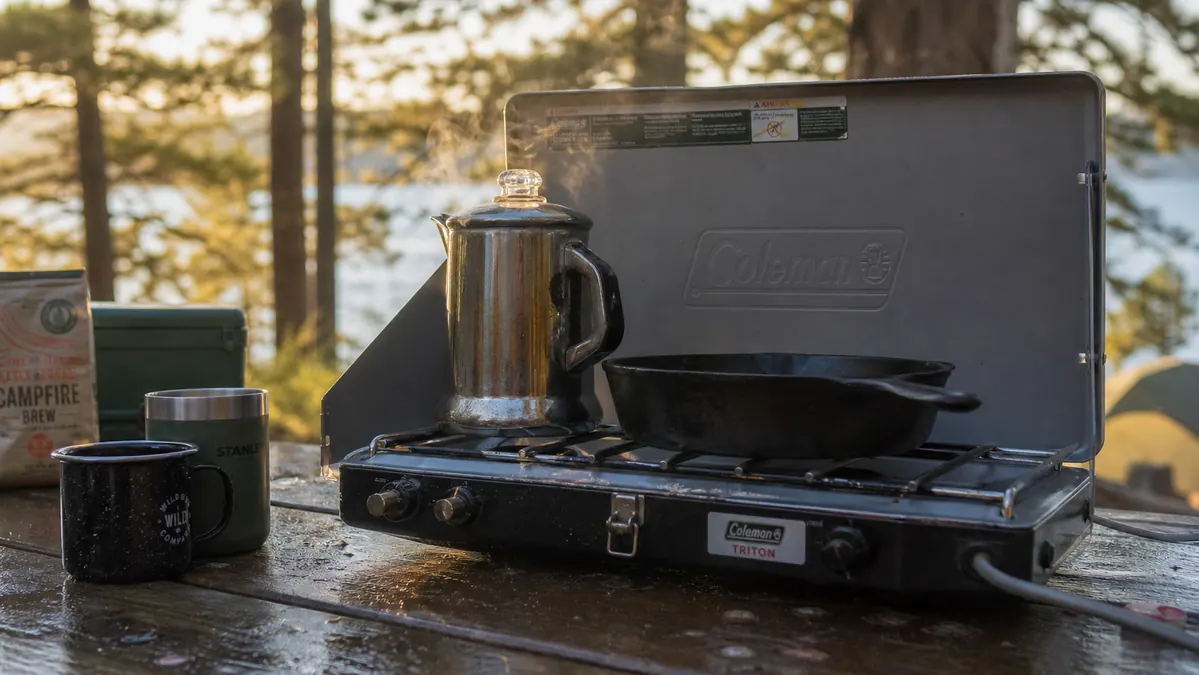
If you just want the short answer: the Gas One Propane Double Burner is the stove that's still riding in the back of my truck three seasons later. I ran a Coleman Triton for two summers before that, and it did honest work right up until the wind picked up along the lakeshore or I needed to hold a real simmer under a pot of chili for the better part of an hour. Both stoves will get eggs and bacon on the table fast on a calm morning. Only one of them kept a low, even flame without me babysitting the dial the whole time I cooked.
I'm not a backpacker weighing grams on a kitchen scale. I'm a car camper who drives a loaded SUV to a campground or a dispersed forest service site, unloads a full kitchen box, and cooks real meals for a family of four over a weekend. That's the lens for this whole comparison. The Gas One stove and the Coleman Triton both sit in that same double burner, propane-fed, car camping category, and after using both back to back at actual campsites, the differences show up fast once you're cooking anything more complicated than instant oatmeal.
These two stoves also land in roughly the same price bracket, which is part of why I get asked about them together so often. Neither one is the budget single burner you grab for a single overnight, and neither is a expedition-grade setup meant for guided trips. They're both aimed at the same buyer: someone who camps most weekends from spring through fall and wants a stove that can cook a full breakfast for the family without turning into the whole morning's project. Check today's price on each before you decide, since retail pricing shifts, but expect them to sit close enough that price alone shouldn't be the deciding factor.
| Spec | Gas One Double Burner | Coleman Triton |
|---|---|---|
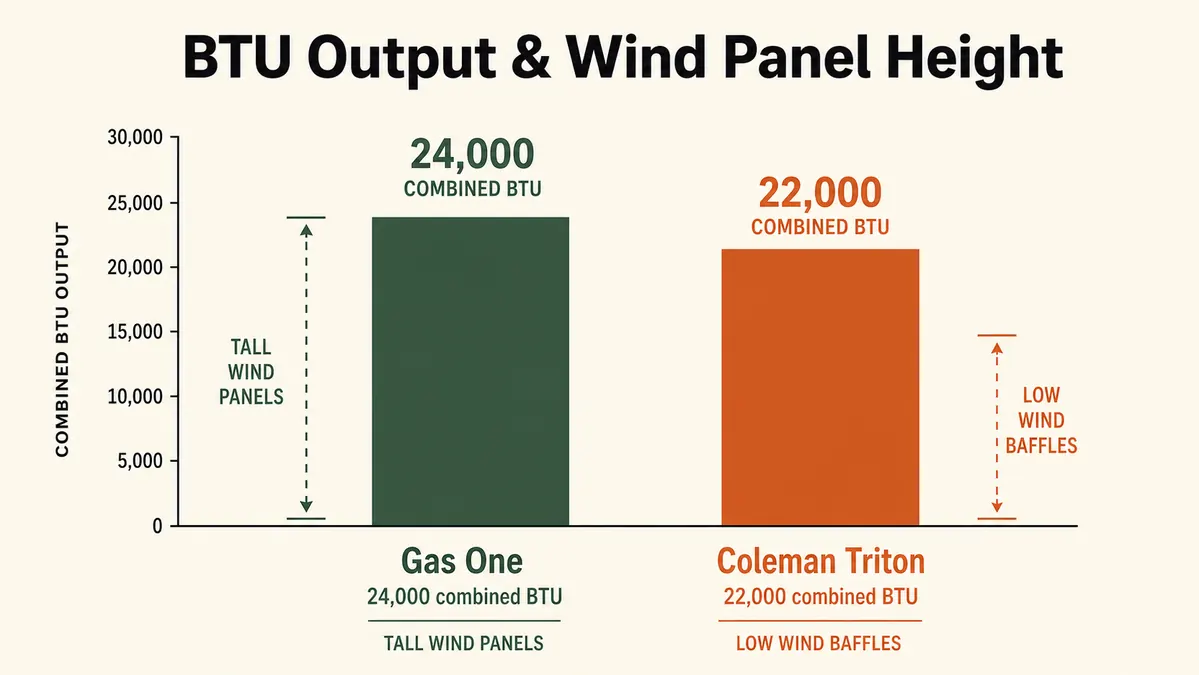
| Combined BTU output | 24,000 BTU (2 x 12,000 BTU burners) | 22,000 BTU (2 x 11,000 BTU burners) |
| Fuel connection | Detachable high-pressure hose, threads onto a standalone 20 lb propane tank | Fixed regulator, mounts a small 1 lb disposable propane cylinder directly into the base |
| Wind protection | Full-height fold-up wind panels on three sides | Low fold-down wind baffles, roughly ankle height |
| Burner construction | Cast stainless steel burner heads | Painted steel burner heads |
| Simmer control | Wide dial range, holds a steady low flame under a stockpot | Narrow dial range, tends to jump from low to medium with a small twist |
| Folded footprint | 18.5 x 15 x 6 inches | 20.9 x 14.1 x 5.5 inches |
| Weight | 11.5 lbs | 13 lbs |
How I Tested Both Stoves at Actual Campsites
The Coleman Triton was my stove of record for two full seasons of weekend trips, roughly 20 nights out, before I retired it. The Gas One has now done a full season and change, including a ten-day stretch at a state park in October where mornings hit the low 40s and afternoons stayed windy off the reservoir. I cooked the same rotation of meals on both: pancakes, bacon and eggs, a Dutch oven cobbler on the side burner, a big pot of camp chili, and pasta with a simmered sauce. I go into more detail on that stretch of testing in my long-term Gas One review if you want the full trip-by-trip breakdown.
I didn't run a lab test with a thermometer clamped to every burner. What I tracked was simpler and more useful for a weekend camper: how long it took to get a pot of water rolling, whether the flame held steady when the wind kicked up off the water, and whether I could actually simmer something without standing over the dial the entire time. Those are the three things that actually matter when you're feeding a family instead of just boiling water for coffee.
I also paid attention to how the kids reacted, which sounds silly until you've tried to keep two hungry ten-year-olds patient at a picnic table. On the Triton, breakfast for four usually ran close to 20 minutes once you count the flame surging when the wind shifted and me having to relight the low side. On the Gas One, the same breakfast has settled into something closer to 14 or 15 minutes, mostly because I'm not stopping to fight the flame every few minutes. That's not a huge number on paper, but at 7am with cranky kids, it's the difference between a calm morning and a short-tempered one.
Where the Gas One Wins
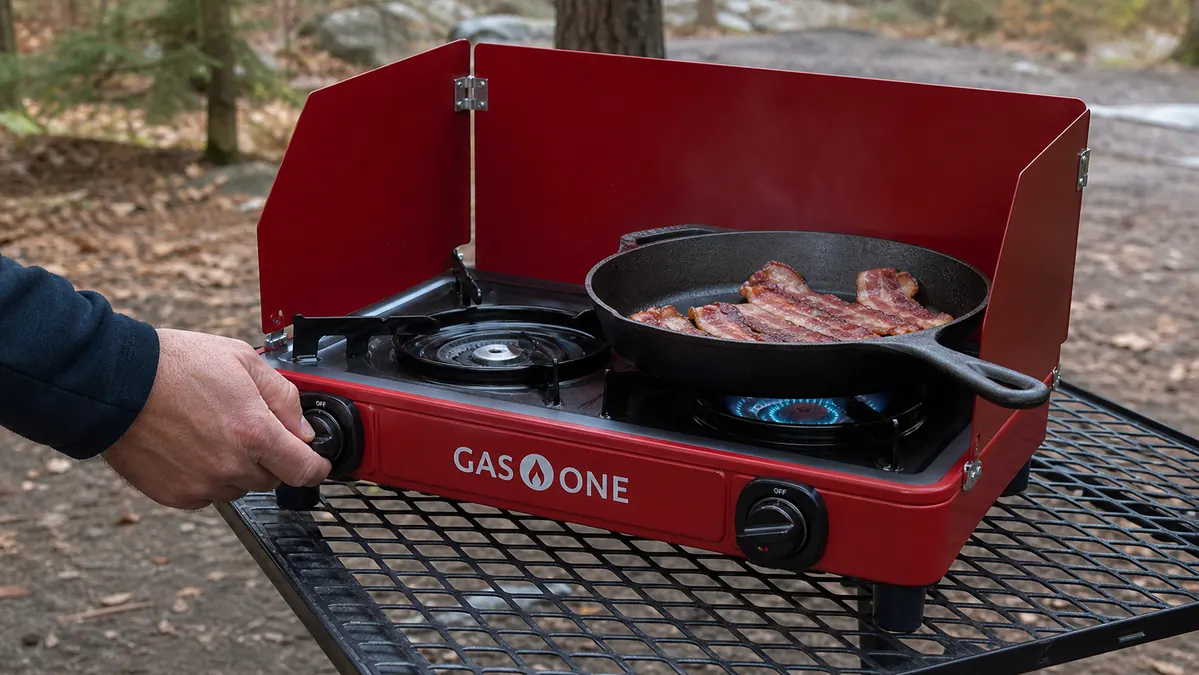
The wind panels are the single biggest difference. The Gas One's panels fold up on three sides and stand tall enough to actually block a burner flame from a steady 10 to 15 mph breeze, which is a normal Tuesday afternoon at most lake campgrounds I've cooked at. The Coleman Triton's baffles are low, more of a suggestion than a wind block, and on breezy days I watched the flame lean sideways enough that a pot of water took noticeably longer to boil. Gas One rates the stove at 24,000 combined BTU across both cast stainless burners, and in practice that extra output plus the taller panels means it recovers heat faster after you lift a lid to stir.
The other place Gas One pulls ahead is simmer control. The dial has enough range that I can hold a pot of chili at a lazy bubble for 45 minutes without the flame surging up every time I bump the table. That matters more than raw BTU once you're cooking anything beyond eggs. The high-pressure hose setup also means I'm running off a full 20 lb tank instead of swapping small canisters mid-meal, which sounds minor until you're elbow deep in a Dutch oven cobbler and realize the little cylinder just ran dry.
Build quality shows up over time more than on day one. The Gas One's burner heads are cast stainless steel, and after a season of use, including a couple of trips where I packed it away still slightly damp from morning dew, I haven't seen any rust starting on the burner ports themselves. The grates are heavy enough that I don't worry about warping them if I set a full cast iron skillet down harder than I mean to. It's the kind of detail you don't notice until the second or third season, which is exactly when a cheaper stove starts showing its age.
Where the Coleman Triton Wins
To be fair to the Triton, it earns its keep in a couple of specific spots. If you're doing quick overnight trips and don't want to haul a full propane tank and hose, the direct-mount small cylinder is genuinely more convenient. Screw the little canister in, light it, cook, done. No hose to coil up, no separate tank taking up trunk space. For a one-night trip where you're just making coffee and a couple of grilled cheese sandwiches, that simplicity is worth something.
Coleman's parts and accessory availability is also hard to beat. Every big box store within an hour of my house carries Coleman fuel canisters and replacement parts, so if something breaks or you forget fuel, you're not stuck. The Triton folds down a touch flatter too, which matters if you're tight on space in a smaller vehicle or you're stacking gear in a rooftop cargo box. Neither of those advantages changed my mind about which stove I reach for on a weekend where I actually plan to cook, but they're real reasons some campers stick with it.
If my camping consisted only of one-night stops between trailheads, I'd probably still be running the Triton. It's a fine stove for boiling water and heating a can of chili. It's once you start planning an actual weekend menu, breakfast Saturday and Sunday, a real dinner Saturday night, maybe a cobbler for dessert, that the gap between the two stoves opens up.
Tired of chasing a flame the wind keeps blowing sideways?
The Gas One's tall wind panels and 24,000 BTU output are the two things that actually solved my windy-lakeside cooking problem. Check today's price on Amazon before your next trip.
Amazon Check Today's Price on Amazon →What a Full Season of Use Looks Like
A stove earns or loses trust in the second and third month, not the first week. By the end of my first full season with the Gas One, I'd packed it wet a handful of times, dropped a lid on one burner grate hard enough to leave a mark, and never once cleaned it properly between trips beyond wiping down the top with a rag. It still lights on the first turn of the dial every time, and the wind panels still fold flat without sticking. That kind of ordinary neglect is closer to how most weekend campers actually treat their gear than the careful maintenance schedule you'll read about in a manufacturer's manual.
The Coleman Triton held up fine too over its two seasons with me, to be clear. This isn't a durability knock against Coleman as a brand. It's that the specific combination of cast stainless burners and taller wind panels on the Gas One means it needs less babying to get the same result, and after enough weekends of cooking for a hungry family, less babying is worth more than almost anything else on the spec sheet.
The Triton got the job done for two seasons. The Gas One is the first stove that let me stop thinking about the stove and just cook dinner.
A Word on Propane Safety at Camp
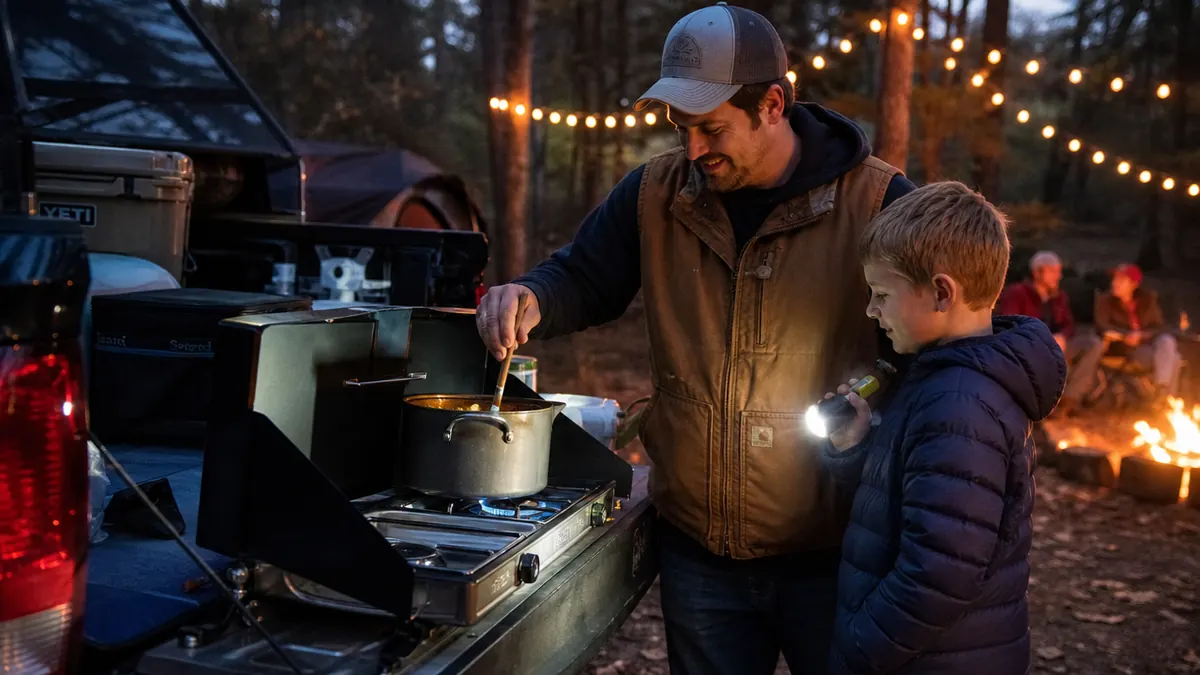
Whichever stove you pick, this part isn't optional. A propane camp stove is built to burn outdoors, in open air, full stop. Never light or run either stove inside a tent, a screen room with the sides zipped down, a camper awning that's fully enclosed, or your vehicle. Propane combustion eats up oxygen and produces carbon monoxide, and an enclosed space traps both. Cook on the picnic table, the tailgate, or a camp table set well clear of tent walls, and keep a fire extinguisher or a bucket of water within reach. This applies to the Gas One just as much as any other stove on the market, no exceptions.
Beyond the enclosed-space rule, keep an eye on connection points. I check the hose fitting on my Gas One at the start of every trip with a quick soapy water test, a few bubbles at the joint means it's time to tighten or replace the washer before I light anything. If you want a full walkthrough of how I actually plan and cook a weekend's worth of meals on a double burner, including how I stage prep so I'm not standing over the stove longer than I need to, I laid it out step by step in how to cook full meals at camp with a stove.
Who Should Buy Which
If you're feeding more than two people, cooking anything that needs a real simmer, or camping somewhere with regular wind, the Gas One is the stove I'd point you to. The taller wind panels and wider simmer range are the two upgrades that showed up on almost every trip, not just the occasional bad-weather weekend. If your camping is mostly quick one-night stops where you're boiling water for coffee and maybe a packet of oatmeal, the Coleman Triton's grab-and-go canister setup is a reasonable, lighter-commitment option. I put together a broader case for why the double burner format itself beats a single burner in 10 reasons double burner stoves beat single burner, and if you want the unfiltered pros and cons list on the Gas One specifically, that's in my honest Gas One review.
Ready to stop rationing your camp meals to whatever the wind allows?
After three seasons of real weekend trips, the Gas One double burner is the one that stayed in rotation. See today's price and current availability on Amazon.
Amazon Check Today's Price on Amazon →