
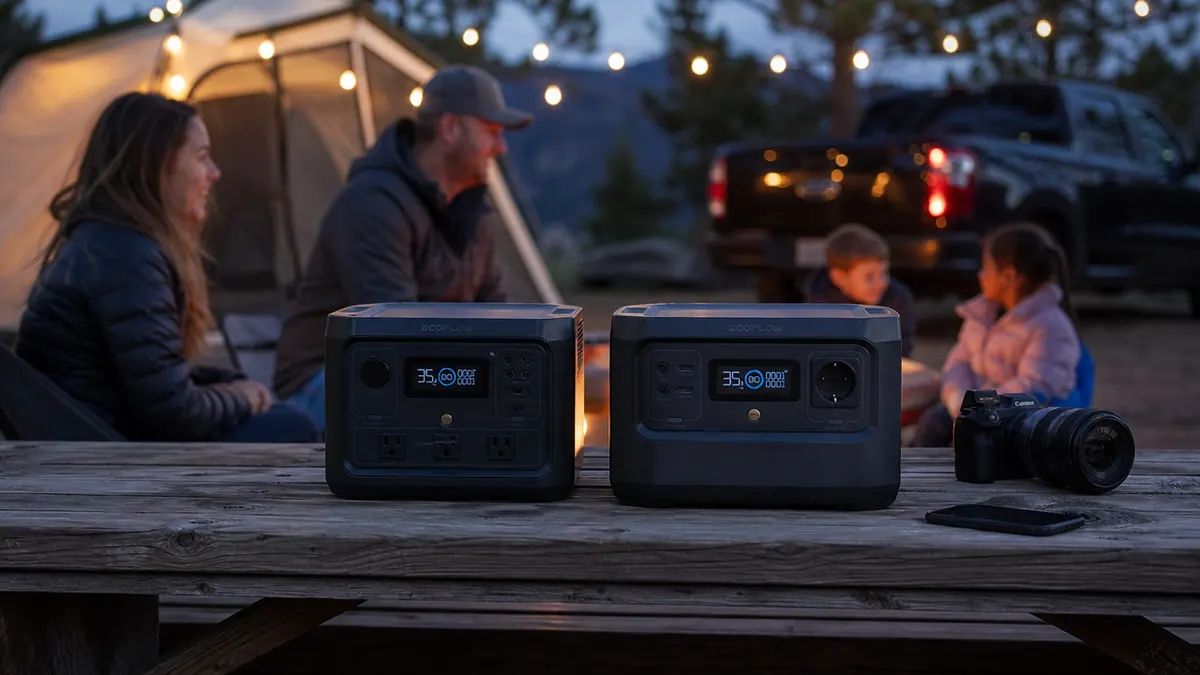
If you camp out of a truck or an SUV instead of a backpack, and you're stuck deciding between the Anker 521 Portable Power Station and the Jackery Explorer 300, here's the short version after running both through actual camp weekends this season: the Anker 521 is the one I keep loading into the truck. It's not because it holds more raw power. It doesn't. It's because of what's inside the case.
I run a home-base setup at most sites now, a folding table, a two-burner stove, a headlamp charging station, sometimes a portable fan for the tent on the humid nights. Both of these power stations get recommended on camping forums as budget-friendly entry points into solar-capable power, and both will keep phones and a fan running through a normal weekend. The real difference between the Anker 521 and the Jackery Explorer 300 doesn't show up on trip one. It shows up around trip fifteen.
Both the Anker 521 and the Jackery Explorer 300 land in the same rough weight class, the same price bracket, and the same 250-300Wh capacity tier that most car camping gear guides point new buyers toward. On a spec sheet in a browser tab, they look close enough to flip a coin. Pack either one into a truck bed for a real season, spring opener through the last chilly weekend in October, and the coin flip stops feeling fair. That's the whole reason I wanted to put the Anker 521 and the Jackery Explorer 300 side by side instead of just listing numbers.
| Spec | Anker 521 | Jackery Explorer 300 |
|---|---|---|
| Battery Chemistry | LiFePO4 (lithium iron phosphate) | NMC (lithium nickel manganese cobalt) |
| Rated Cycle Life to 80% Capacity | About 3,000 charge cycles | About 500 charge cycles |
| Capacity | 256Wh | 293Wh |
| Rated Output | 200W continuous, 400W surge | 300W continuous, 500W surge |
| Full Wall Recharge Time | About 7 hours | About 5.5 hours |
| Ports | 6 ports: 2 AC, 2 USB-A, 2 USB-C | 3 ports: 1 AC, 1 USB-A, 1 USB-C |
| Weight | 7.9 lbs | 7.1 lbs |
| Current Price Position | Usually the lower current price of the two | Usually a higher current price for the extra capacity |
Where the Anker 521 Wins
The single biggest difference between these two power stations is the battery chemistry, and it's not marketing spin. The Anker 521 uses a LiFePO4 cell, the same core chemistry showing up in higher-end power stations that cost twice as much. Anker rates it for roughly 3,000 charge cycles before the battery drops to 80% of its original capacity. The Jackery Explorer 300 uses an NMC lithium cell, rated closer to 500 cycles for that same 80% mark. For someone who camps most weekends from spring through fall, that gap is the difference between a power station still doing its job in year six and one you're shopping to replace by year two.
I've had my Anker 521 out for a full season now, somewhere north of 40 nights of actual use between car camping trips and a handful of driveway test runs charging camera batteries for a neighbor kid's science fair project. It still holds an overnight charge close to the way it did back in April. That's the LiFePO4 chemistry doing its job quietly, not luck, and not babying the unit.
There's a safety angle to the chemistry difference too, and it's worth saying plainly instead of burying it in a footnote. LiFePO4 cells run cooler and are far more thermally stable than NMC cells, which is part of why Anker can rate the 521 for so many more cycles in the first place. I've left mine charging in a hot truck cab on a 90-degree afternoon without giving it a second thought. I wouldn't do that with every battery I own, and I don't think most campers would either.
Where the Jackery Explorer 300 Wins
The Jackery Explorer 300 isn't a bad unit, and I want to be straight about that instead of pretending it has no case at all. It holds 293Wh compared to the Anker 521's 256Wh, so if you're squeezing every last watt-hour for a CPAP machine or a portable fridge running overnight, that extra headroom is real and it matters. The rated output is a bit higher too, 300W continuous versus the Anker 521's 200W, which means it shrugs off a slightly hungrier appliance without tripping into overload.
Jackery's companion app and screen readout are also a touch more polished if you like checking your remaining power from your phone at the picnic table instead of glancing at the unit itself. That's a genuine preference for some campers, even if it doesn't change how much usable power actually reaches your gear over a weekend.
If your camping season is short, say a handful of trips a year rather than a full spring-to-fall rotation, the Jackery Explorer 300's faster wall recharge and slightly higher output can outweigh the cycle-life gap in practice. A battery rated for 500 cycles is still plenty of life if you're only running it through 15 or 20 charge cycles a year. The math changes with how often you actually load the truck.
Six times the charge cycles for a lower current price. That math is hard to argue with.
The Anker 521's LiFePO4 battery is built to still be working long after a comparable NMC unit has faded. See today's price and current availability on Amazon.
Amazon Check Today's Price on Amazon →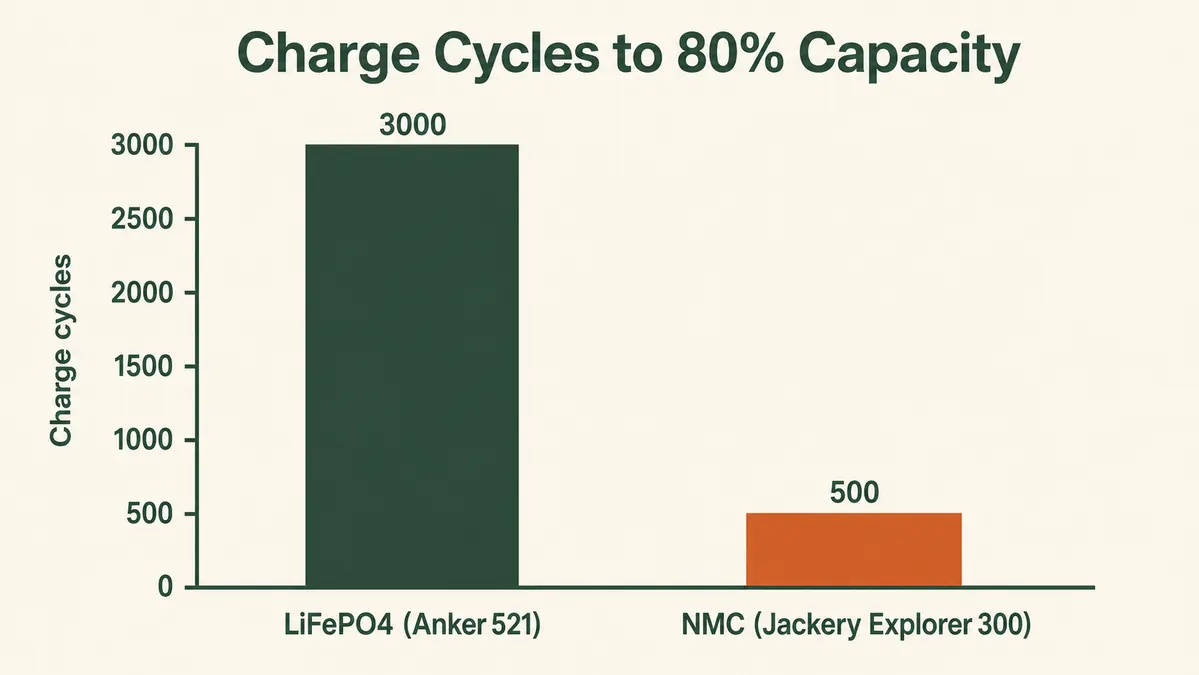
Charging Speed and Recovery at Camp
Recharge speed matters more once you're three days into a trip and your rooftop panel is doing the job solar panels usually do, less than the box promised. Plugged into a wall outlet the night before you leave, the Anker 521 gets to a full charge in about 7 hours. The Jackery Explorer 300 is quicker on paper, closer to 5.5 hours on the same wall outlet, thanks to a higher-wattage charging input. If you're the kind of camper who tops off the night before every trip, that gap barely registers. If you're the kind who remembers Thursday night for a Friday morning departure, it's worth planning around.
Neither one fast-charges the way a phone does. Solar recharge times stretch out further for both units, so I treat either power station the way I treat a cooler: pack it full before you leave the driveway and don't count on topping it off mid-trip.
Running Small Appliances: Fridges, Fans, and CPAPs
This is where the Jackery Explorer 300's extra capacity and higher rated output show up in real terms. A 12V portable fridge pulling somewhere around 40-60 watts will run longer on the Jackery Explorer 300's 293Wh than on the Anker 521's 256Wh, though the gap in practice is closer to an hour or two over a full overnight cycle than a dramatic difference. A CPAP machine is the appliance where I'd actually pay attention to the numbers, since it draws power continuously all night and there's no room for the unit to tap out at 2 a.m.
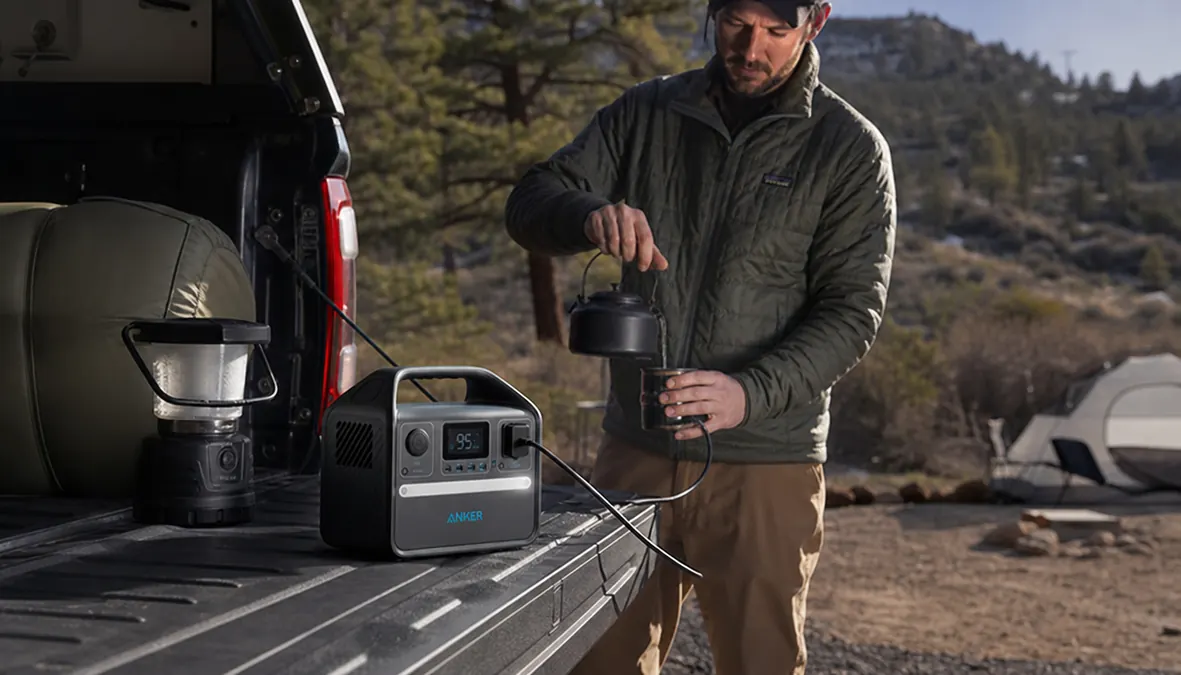
For a box fan, a string of camp lights, charging phones and a tablet, or running a coffee maker for five minutes in the morning, the Anker 521's 256Wh and 200W continuous rating handle all of it without strain. I've run my two-burner induction plate off the Anker 521 for a quick reheat and it didn't blink. The Jackery Explorer 300 gives you a bit more ceiling for anything that pulls a steady, higher wattage load all night long.
Ports, Weight, and Everyday Handling
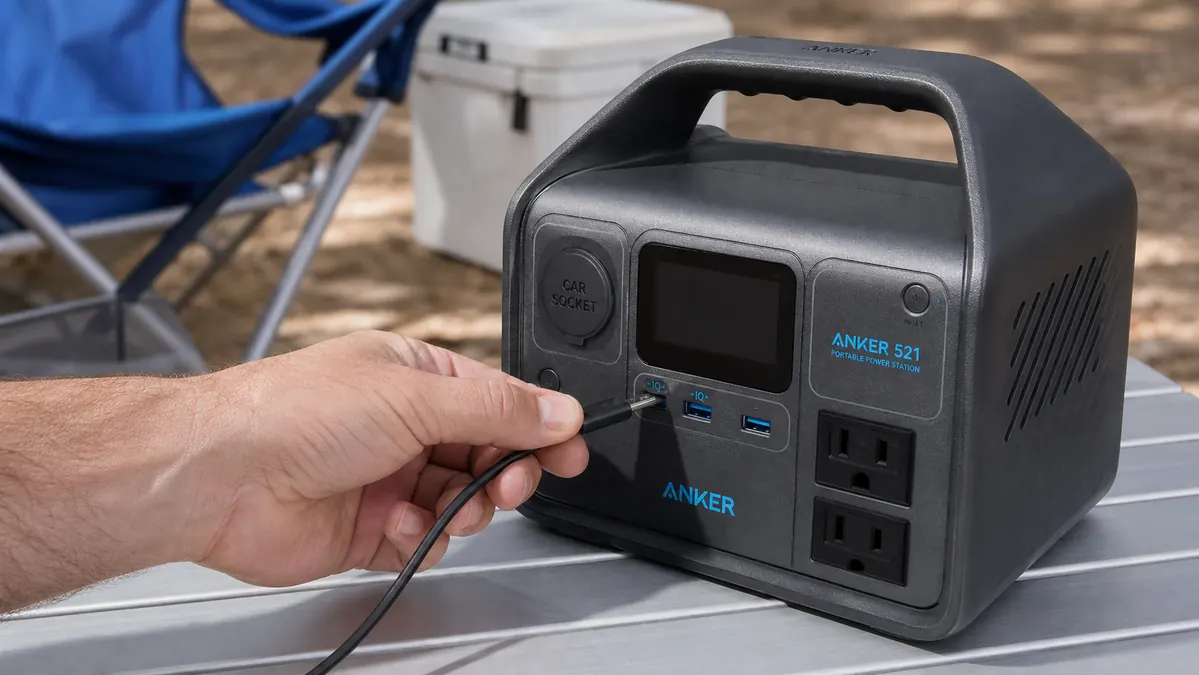
The Anker 521 packs six ports into its case, two AC outlets, two USB-A, and two USB-C, which covers more devices running at once than the Jackery Explorer 300's three-port layout. That matters more than it sounds like at a shared campsite when everyone's phone, headlamp, and camera battery all need juice at the same time and nobody wants to unplug someone else's cord. At 7.9 lbs, the Anker 521 sits close to the Jackery Explorer 300's 7.1 lbs, light enough that either one rides in a truck bed tote without complaint or a second thought.
Handling-wise, both units have a rounded carry handle molded into the top of the case, and both survive being set down on gravel or a wet picnic table without drama. The Anker 521's casing has held up fine through a season of truck bed rides, tailgate landings, and one accidental knock off a camp chair onto packed dirt. Neither power station is meant to be dropped from height or left out in real rain, so I keep a small dry bag over either one when the forecast turns, which is just good sense for any electronics at a campsite.
What a Full Season Actually Looks Like
I keep the Anker 521 in the truck from the first warm weekend in April through whatever weekend in late October finally turns cold enough to call it. That's usually somewhere between 18 and 22 trips a year for my family, counting the two-night quick getaways and the full week we take every summer. Run the math on charge cycles and that's roughly 20 to 25 years before the Anker 521's LiFePO4 battery even approaches its rated 3,000-cycle mark, assuming one full charge cycle per trip.
The Jackery Explorer 300, at the same pace, would be approaching its rated 500-cycle mark somewhere around year 20 to 25 as well, on paper. In practice, NMC cells tend to lose noticeable capacity well before they hit their rated cycle count, especially if they sit at a full charge in a hot truck for days at a stretch the way camping gear does. LiFePO4 cells are simply more forgiving of that kind of real-world abuse, which is a big part of why I trust the Anker 521 to still be pulling its weight several seasons from now.

Price and Long-Term Value
Check current Amazon listings and you'll usually find the Anker 521 sitting at a lower current price than the Jackery Explorer 300, which already tilts the math in the Anker 521's favor before you even factor in the battery chemistry. Pay less up front for a unit rated to outlast the competition by roughly six times the charge cycles, and the value case gets hard to argue with. The Jackery Explorer 300's slightly higher capacity and output are real advantages, but they come at a higher current price for a battery that's likely to need replacing well before the Anker 521 does.
A full season of car camping taught me the number that matters isn't watt-hours. It's charge cycles.
Who Should Buy Which
If you camp most weekends from spring through fall the way I do, or you're building a power station into a semi-permanent car camping setup, the Anker 521 is the smarter buy. The LiFePO4 chemistry means it's still doing its job long after a comparable NMC unit has faded, and the extra ports come in handy every single trip. I broke down the season-by-season details in my full Anker 521 long-term review if you want the deeper look. If you only camp a handful of weekends a year and want extra headroom for a CPAP machine or a fridge, the Jackery Explorer 300's higher capacity and output make sense for that lighter use pattern. And if you're still deciding whether a power station beats hauling a generator to your site at all, my rundown on why portable power stations beat generators at camp covers the basics before you spend a dollar.
Built for weekends that turn into a whole season of camping.
If the charge-cycle math above sold you, the Anker 521 is worth a look at today's price before your next trip.
Amazon Check Today's Price on Amazon →